
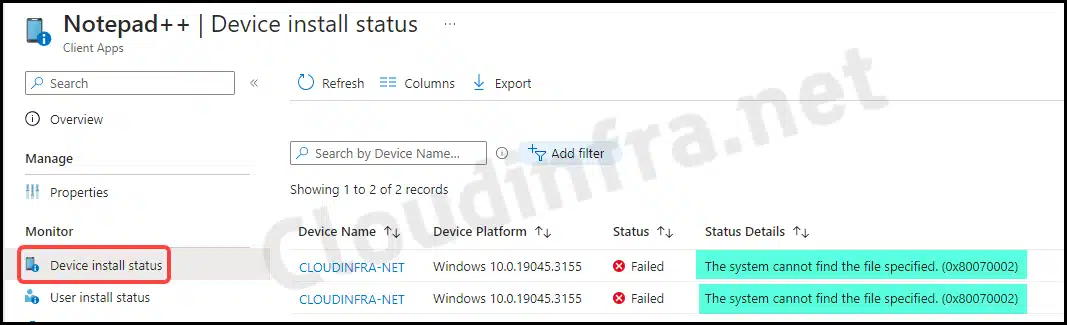
In this blog post, I will show you how to fix Intune Win32 app install error 0x80070002. When a Win32 app deployment fails in Microsoft Intune with error code 0x80070002, the failure almost always means Windows could not find a file referenced during execution. In practical terms, Intune successfully delivered your Win32 content to the device, but the install or uninstall command line points to a file or path that is not present at runtime, so the process cannot start. On the Intune admin center, you will see an error message: The system cannot find the file specified (0x80070002) [refer to the below screenshot].
Contents
What does 0x80070002 mean?
0x80070002 maps to the Windows file not found scenario. You typically see it when you specify an install or uninstall command in Win32 app deployment that references:
- a file name that does not exist (typo, wrong file name).
- an incorrect path (hard-coded path not present on the device).
- a file that was not packaged into the .intunewin content.
- a missing file extension (.exe, .msi, etc.).
Before you start
Before changing your app configuration, collect evidence from the device so you can identify and address the correct root cause. Collect and review Intune Management Extension (IME) logs from the Windows device. Win32 app execution details are recorded in the IME logs located at C:\ProgramData\Microsoft\IntuneManagementExtension\Logs.
Open the latest IntuneManagementExtension.log and AgentExecutor.log files to identify any failures. Determine whether the failure occurred during the Install or Uninstall phase, as the remediation steps depend on which command is failing.
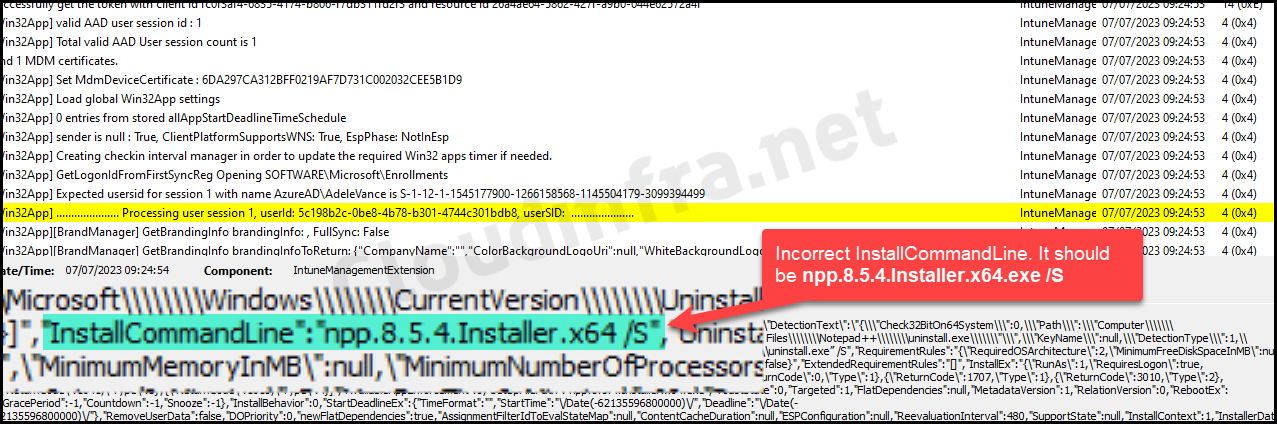
Here is a screenshot from the Intune Management Extension log file (IntuneManagementExtension.log) related to the Notepad++ app deployment. As shown in the log, the specified InstallCommandLine is npp.8.5.4.Installer.x64 /S instead of npp.8.5.4.Installer.x64.exe /S. The missing file extension in the command caused the application deployment to fail with an error code 0x80070002. To resolve the issue, correct the install command in the Win32 app deployment.
Fix Intune Error Code 0x80070002
As observed in the IME logs above, Install command specified in the Win32 app deployment is incorrect. Let’s open the Win32 app deployment and correct the command.
- Sign in to the Intune admin center > Apps > All Apps.
- Click on the Win32 app deployment. For example, Notepad++.
- Click on Properties and then click on Edit next to Program.
Fix 1: Misconfigured Install Command Example
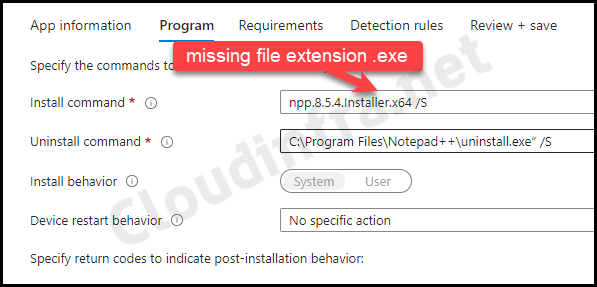
The screenshot below shows the misconfigured install command. You will notice that the .exe file extension is missing from the command.
Update Install Command
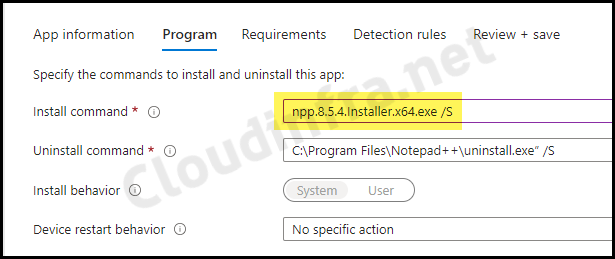
The screenshot below shows the correct Install command with the file extension included. If you identify an issue with the Uninstall command, correct it as well and save the application. The app will automatically redeploy to the target Entra group.
Fix 2: Your command line references a path that does not exist on the device
If your command line includes a local path that does not exist, for example, C:\Temp\setup.exe or C:\Users\SomeUser\Downloads\setup.exe then the install or uninstall will fail unless that exact path exists on every target device. To fix the issue, follow below steps:
- Repackage the Win32 app so the installer is included inside the .intunewin.
- Update the Intune install and uninstall command to reference the packaged file name (not a device-specific path).
- Re-deploy and confirm via IME logs.
Fix 3: The referenced file is not included in the Win32 package
Sometimes the command line is correct, but the file simply was not packaged (common when the source folder used with the Win32 Content Prep Tool did not include all required files). Below are the steps to resolve this issue:
- Verify your Win32 source folder contains the installer and any required transforms/config files.
- Recreate the .intunewin using the correct source folder.
- Update the Win32 app in Intune with the corrected content, then retry.
Fix 4: The installer exists, but your command line is not quoted correctly
If your installer name or arguments include spaces, missing quotes can result in Windows attempting to execute the wrong token, which can manifest as “file not found”.
- Wrap the executable path and any file-path parameters in quotes.
- Example pattern: “setup.exe” /silent /log “C:\ProgramData\Vendor\AppInstall.log”
- Save the updated command line and retry.
Fix 5: You are calling a PowerShell script, but the script path is wrong
If your Win32 app runs PowerShell (for example Install.ps1), the most stable approach is to call PowerShell explicitly and ensure the script file is included in the package.
- Ensure
Install.ps1exists in the packaged content. - Use an explicit PowerShell command line, for example: powershell.exe -ExecutionPolicy Bypass -NoProfile -File .\Install.ps1
- Confirm in IME logs that the script is being invoked as expected.
Recommendations to prevent 0x80070002 going forward
Most 0x80070002 incidents are preventable with a few consistent standards:
- Keep installer names simple (avoid special characters and inconsistent naming).
- Do not hard-code device-local paths in install commands.
- Always quote file paths when arguments include spaces.
- Validate the packaged content before upload, especially when installers rely on companion files.
- Treat IME logs as the source of truth for the executed command line and runtime failure.
Conclusion
Intune Win32 error 0x80070002 is a straightforward problem once you treat it as what it is: a file-not-found execution failure. Use IME logs to identify the exact failing install or uninstall command line, then apply the matching fix: correct the file name or extension, remove invalid paths, ensure all required files are packaged, and quote command lines properly.
